The General Assembly of Game Developers (GDC Games Festival) recently published a 2026 survey of the state of the game industry, which revealed a wide range of insights from professionals in different fields. A survey conducted by the Informa Joint Research Institute, Omadia, shows that the whole game industry is surrounded by a wave of layoffs and that developers are hit hard by AI.
The survey received responses from 2,300 professionals, a 23 per cent decrease over the same period. Sixty-two per cent of the respondents worked in games companies or studios, 45 per cent of them in independent studios, 31 per cent in 3A studios, 18 per cent from 2A studios and 6 per cent in cooperative development studios. Retrenchment continues. Retrenchment is a major issue facing the industry as a whole, with 28 per cent of respondents experiencing retrenchment in the past two years, rising to 33 per cent of United States developers. The rate of dismissal in the past 12 months was 17 per cent, up from 11 per cent in 2025 and 7 per cent in 2024. The actual number may be higher, as some interviewees may have been dismissed several times during this period.
♪ After a big, big job lay-offs ♪
Game designers (including narrative designers) were the most affected, with 20 per cent unemployed; business operations and service assignments were the least affected, at 8 per cent. Of those laid off, 48 per cent have yet to find new jobs. 3A studio employees are more likely to experience lay-offs, with two thirds indicating that there have been lay-offs in their company, compared with only one third in independent studios. Among the students involved in the survey. Seventy-four per cent are concerned about their employment prospects in the game industry as a result of job losses. Trade unionization support rates have increased significantly The willingness of workers to join trade unions has increased, perhaps in connection with job losses. Owing to differences in national legislation, the issue was addressed only to respondents in the United States, showing 82 per cent support for trade unionization in the game industry, 5 per cent opposition and 13 per cent unclear attitudes. The 2026 survey updated the structure of the problem and therefore could not be directly compared with last year. The highest levels of support include staff with annual salaries of less than $200,000 (87 per cent), laid-offs in the last two years (88 per cent) and groups under 45 years of age (86 per cent). None of those interviewed between the ages of 18 and 24 objected to unionization.

“R. Star’s laid off staff.”
For the first time, respondents were asked whether they were members of trade unions: 2 per cent indicated that they were members of exclusive trade unions of companies, 10 per cent were members of industrial trade unions and 62 per cent were not members but intended to participate. AI uses and disputes Thirty-six per cent of respondents indicated that AI was used in their work, but to varying degrees in various areas. The use of AI tools is lower among game studio employees (30 per cent) than among distribution companies, support teams and market/public relations companies (58 per cent). The use of business jobs (58 per cent) is much higher than other positions. Forty-seven per cent of senior managers use the AI tool, compared with 29 per cent at the junior level. The average number of heads of studios is 36 per cent.
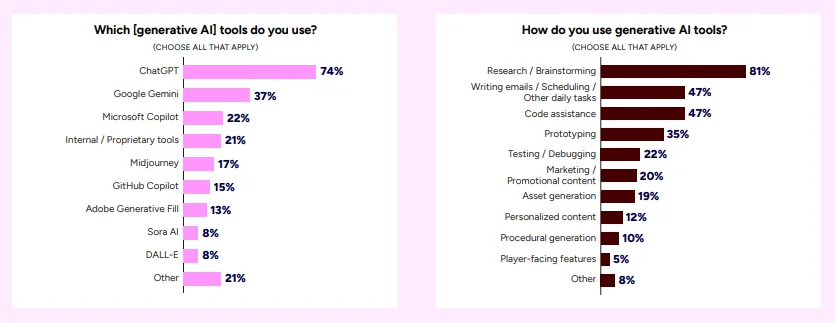
(ChatGPT is the most popular AI tool)
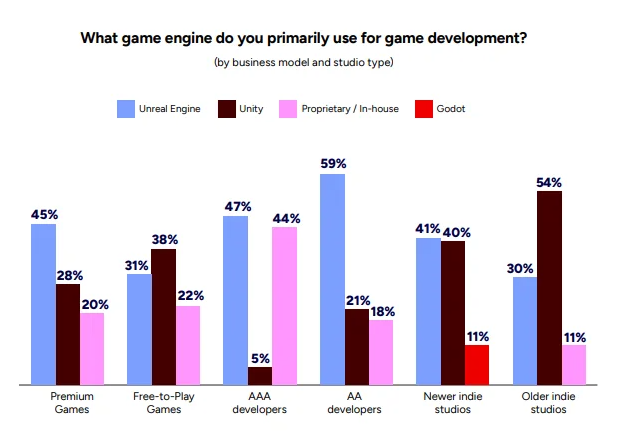
Reliance on the generation of AI tools has been accompanied by a steady rise in negative sentiments towards AI. Fifty-two per cent of the respondents felt that they had a negative impact on the industry, a steady increase from 30 per cent in 2025 and 18 per cent in 2024. The areas of visual and technical fine arts (64 per cent), game design and narrative (63 per cent) and game programming (59 per cent) have the strongest opposition. Only 7 per cent believed that the generation of AI had a positive impact on industry, compared to 13 per cent in 2025. Among this group, executives and business operations services have the highest level of support (19 per cent each). The comprehensive analysis showed that some respondents supported the use of AI for non-creational tasks such as code aids or prototype design, but that 30 per cent opposed the use of AI tools in any form for reasons related to data sources, energy consumption and the risk of AI replacing jobs. Fantasy engines have the highest use of Unity The new data from this year ‘ s survey show a clear lead in the false engine: 42 per cent of respondents listed it as the main engine for game development, compared to 30 per cent for Unity. This may be due in part to a change in the approach to research, which is addressed only to respondents who claim to be engaged in development work. Illustrative engines are more used in 2A (59 per cent) and 3A (47 per cent) studios and Nueva Independence studios (41 per cent); 54 per cent of older independent studios still use Unity engines. The proportion of free game developers using Unity (38 per cent) is higher than that of paid game developers (28 per cent). Eleven per cent of newly independent developers use the Godot engine, but less use in mature studios.