
Meta recently announced that work was under way to introduce a more advanced AI system for content regulation, with plans to reduce reliance on third-party suppliers. The relevant vetting tasks include the identification and removal of elements related to terrorism, child exploitation and fraud.
Meta indicated that it would be fully deployed in its applications once the performance of these advanced AI systems continued to outperform the current content audit methodology. At the same time, the reliance on third-party suppliers for content regulation will be reduced. The official statement of Meta states: “Although we will retain manual audits, these systems will undertake tasks that are more suitable for technical processing, such as double-checking graphic content, or areas where hostile actors are constantly changing, such as illicit drug sales or fraud.” Meta believes that these AI systems are able to detect more violations with greater accuracy, better prevent fraud, respond more quickly to real events and reduce over-enforcement.
Meta states that the results of the early testing of the AI system were effective:It’s been about 5,000 fraud attempts every day:Reducing the success rate of fraudsters who lure users into leaking login information and detecting and deterring about 5,000 fraudulent attempts on a daily basis that had not previously been discovered by any audit team;The number of celebrities impersonating accounts dropped by over 80%:(b) Identification and prevention of more accounts of impersonators and other eminent persons, resulting in a reduction of more than 80 per cent in the number of reports from users of the most often counterfeit accounts;The number of non-compliant inducing content recognition has doubled:(b) Identification of adult incompetence is twice as high as that of the review team, while the error rate is reduced by more than 60 per cent;Improving account security:Effectively preventing the theft of accounts by identifying a series of isolated, seemingly harmless changes in the accounts from their new location, password changes, personal data editing, etc., which AI can identify as a threat;I’m not sure if I’m going to make it.We have detected false websites that use brands of well-known sporting goods stores, are extremely cheap and have suspicious web sites. After extensive testing, AI reduced the number of advertisements containing fraud and other serious irregularities by 77 per cent, providing better protection to users and brands.

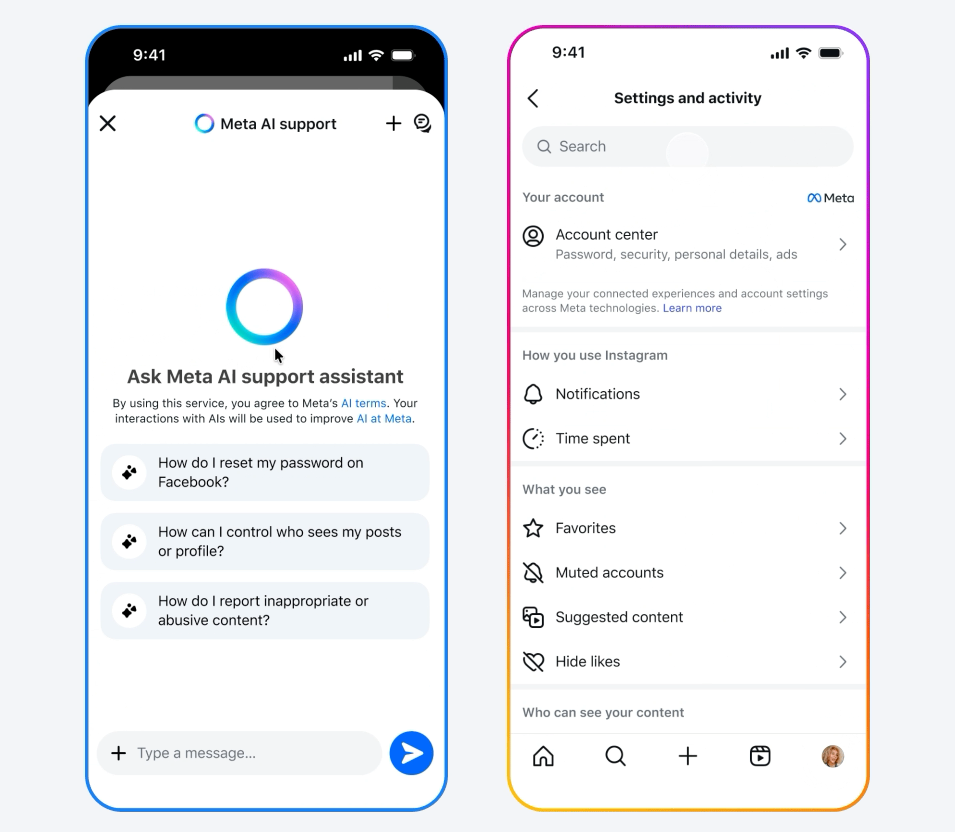
Meta wrote in the official bulletin that “experts will be responsible for designing, training, monitoring and evaluating our AI systems, measuring their performance and making the most complex and influential decisions. For example, manual personnel will continue to play a key role in the most risky and critical decision-making, such as the closure of accounts or reporting to payment agencies.” It is worth noting that during the past year, Meta has continued to relax its rules on content auditing. Last year, Meta terminated the third-party fact-finding project and moved to a community notebook model similar to platform X. At the same time, the restrictions on the topic of “hot words” were eased and users were encouraged to adopt a “personalized” approach to political content. Meta also announced the launch of Meta AI support assistants on Thursday to provide round-the-clock support to users. The assistant will provide global outreach to Facebook and Instagram applications of iOS and Android platforms, as well as to Facebook and Instagram desktop help centres.
