
The social media giant Meta recently published its financial report for the second quarter of the 2026 fiscal year, which amounted to $47.52 billion, with a return of $7.14 per share, which is significantly higher than the analyst ‘ s previous forecast of $44.8 billion and $5.92 per share of the proceeds, and after the release of the financial report, the market price of Meta today rose by 12 per cent. Meta projected that the Q3 battalion would receive between $47.5 billion and $50.5 billion, and the lower threshold of the guidelines ($47.5 billion) would also be more than $1 billion higher than the average of $46.14 billion expected by analysts.
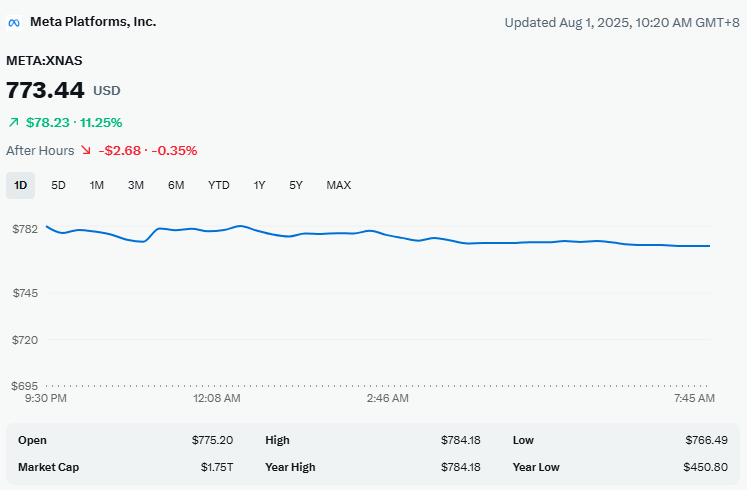
However, while high-profile performance and upward adjustment of the floor of the capital expenditure guidelines (from $62 billion to $64 billion), Meta ‘ s balance sheet reveals an alarming fact: In the first half of 2025, companies consumed up to $32 billion in cash.
During the financial conference, Susan Li, Chief Finance Officer of Meta, revealed that capital expenditure in 2025 would increase by some $30 billion over 2024. She further stated: “Infrastructure planning remains highly dynamic, but we now expect that capital expenditure will again increase significantly at the same level in 2026, as we continue to actively seek to increase capacity to meet the needs of AI R & D and operations.”
In-depth balance sheets show that as at 30 June 2025, the cash and cash equivalents of Meta were only $12 billion. Compared to the data as at 31 December 2024, this means that in just six months its cash reserves have been reduced by 72 per cent. Cash consumption in the first quarter was $15 billion, reflecting a further acceleration in the second quarter.
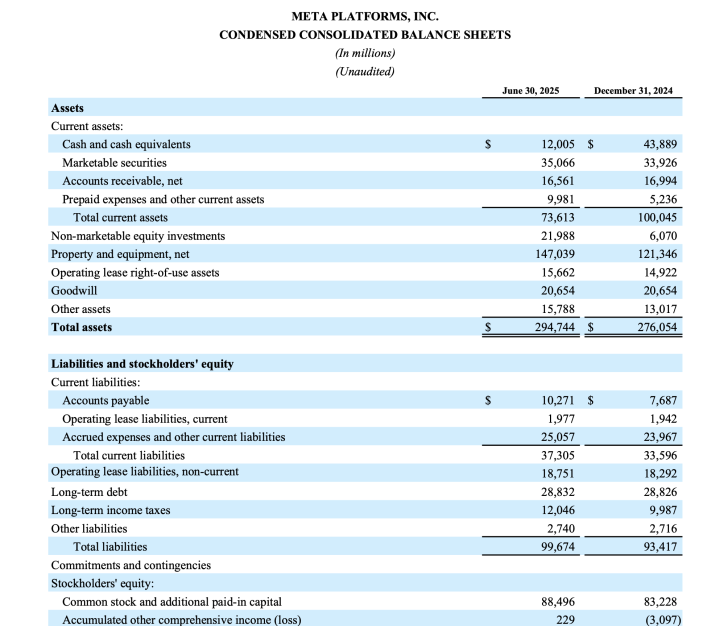
Meta Statement of Liabilities (as at 30 June)
Where is the money? Looking at Meta’s cash flow statement, it can be seen that operating cash flows to $25.6 billion do not amount to $26 billion from investment activities. Investment expenditure also surged during the quarter, with Q2 cash outflows increasing by up to 104 per cent each year.
The core of the funding was the acquisition of property and equipment, amounting to $16.5 billion, or 63 per cent of the investments noted, mainly for the construction of a large AI data centre. An additional $15 billion in equity investment expenditure is likely to reflect its acquisition of ScaleAI (completed at $14.3 billion earlier this year) and its investment in the establishment of “super smart laboratories”.
Chief Executive Officer Mark Zuckerberg of Meta has committed hundreds of billions of dollars to building AI infrastructure. This reminds us of his former “high bet” universe. In 2022, Zuckerberg burned tens of billions of dollars on the dollar universe, leading to a 64 per cent collapse in the stock price of Meta in that year. The “AI heat wave” that began in 2023 gave him the opportunity to turn the wheel in time, and now Zuckerberg has re-enjoyed investors by shifting huge amounts of money from the meta-cosm to the AID data centre.

Despite the over-anticipated increase in equity prices (the 29 per cent increase so far in Meta in 2025), analysts believe that the market needs vigilance. Six months later, $32 billion had been burned, and even large things like Meta were no exception, and the market was concerned about the sustainability of large cash consumption. In addition, can Meta stay ahead and realize Zuckerberg’s vision, with the huge competitive pressure of all the world’s technology giants placing their money on AI?
Zuckerberg is betting on AI in the form of firepower, and the success or failure of this bet will determine the future fate of Meta. The brightness of the financial data temporarily obscures the warning of cash flows, but investors, while cheering for the soaring stock prices, are bound to stare at the burning “cash furnace”.
